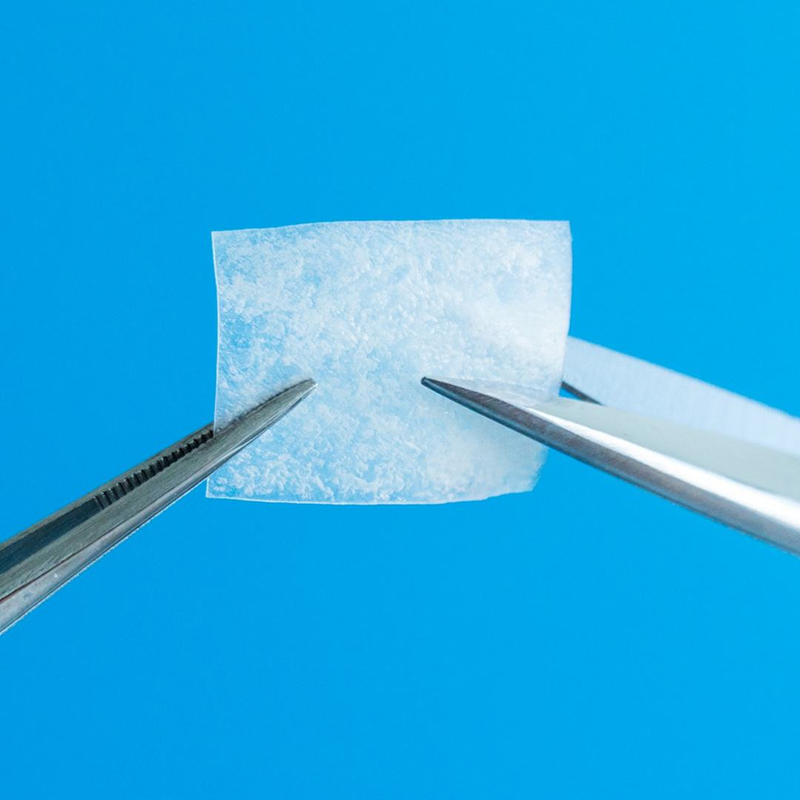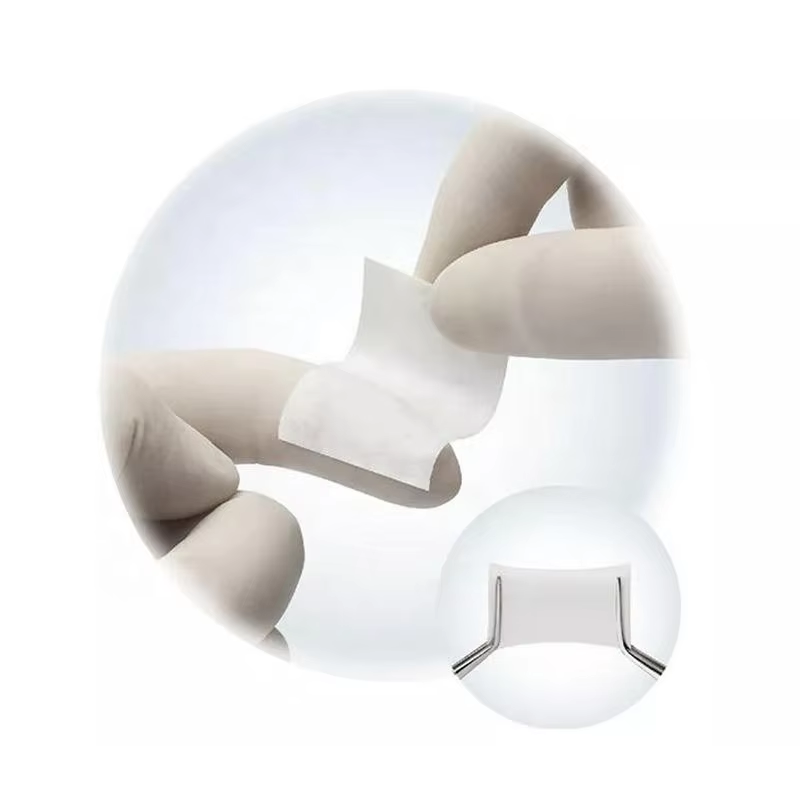
Bone regeneration in implant dentistry relies on controlling how different cell types compete during healing. In guided bone regeneration, the dental membrane acts as a physical barrier that separates soft tissue from the bone defect. Without this barrier, fibroblasts migrate rapidly into the wound site and occupy the space needed for bone regeneration.
The dental membrane prevents this soft tissue invasion and allows slower-moving osteogenic cells to dominate the area. This controlled environment is essential for predictable bone regeneration outcomes. During tissue healing, the absorbable membrane maintains this separation long enough for early bone formation to stabilize.
Bone regeneration requires a much longer healing window than soft tissue repair. The dental membrane provides this critical time window by maintaining space and excluding soft tissue interference.
In guided bone regeneration, clinical outcomes consistently show improved bone density and volume when a dental membrane is used. Rather than directly forming bone, the membrane supports natural bone regeneration by protecting the biological environment.
Space maintenance is a central requirement in guided bone regeneration. If the dental membrane collapses into the defect, the available space for bone regeneration is reduced, leading to insufficient ridge volume.
A stable dental membrane preserves a three-dimensional space that allows organized bone regeneration. This is particularly important in vertical and horizontal augmentation cases where structural collapse is a major risk factor.
In implant dentistry, bone graft materials and the dental membrane function as a combined system. The graft provides internal scaffold support, while the membrane defines and stabilizes the outer boundary of the regeneration space.
Absorbable membrane systems with enhanced stiffness improve this space-maintaining function and contribute to more predictable bone regeneration outcomes.
Modern implant dentistry uses both absorbable membrane systems and non-resorbable barriers for guided bone regeneration. Absorbable membrane technology is increasingly preferred due to reduced surgical invasiveness and improved patient recovery.
An absorbable membrane must maintain barrier integrity throughout the critical bone regeneration phase and then degrade gradually without disrupting tissue healing. Timing is critical, as premature degradation reduces regenerative outcomes.
Mineralized collagen dental membrane systems combine structural support with biological activity. The mineral phase enhances osteoconductivity, allowing better bone regeneration in addition to barrier function.
This dual role makes mineralized collagen membranes particularly valuable in complex implant dentistry cases where both space maintenance and biological stimulation are required.
The internal architecture of the dental membrane plays a major role in tissue healing. Fiber arrangement, porosity, and surface density all influence how the absorbable membrane interacts with surrounding tissue.
A properly engineered dental membrane allows nutrient diffusion while preventing fibroblast penetration, ensuring stable bone regeneration conditions within the guided bone regeneration site.
Bilayer absorbable membrane designs are widely used in implant dentistry. One surface supports integration with bone regeneration processes, while the other prevents soft tissue infiltration.
This asymmetric structure improves tissue healing outcomes by balancing biological exclusion with controlled integration.
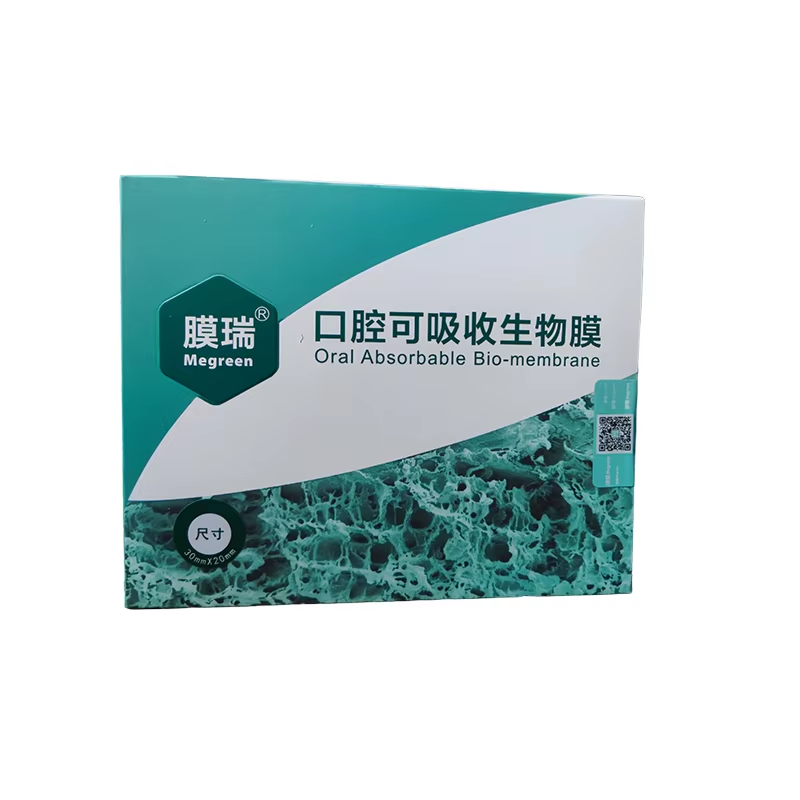
Surgical execution is critical to the success of guided bone regeneration. The dental membrane must be fully covered with tension-free soft tissue closure to prevent exposure.
If the absorbable membrane becomes exposed, contamination risk increases and bone regeneration may be compromised. Proper fixation using tacks or pins improves membrane stability and supports predictable outcomes.
Implant dentistry uses either simultaneous or staged guided bone regeneration approaches depending on defect severity. In both cases, the dental membrane must remain stable throughout the entire healing period.
Correct timing ensures that bone regeneration reaches sufficient maturity to support implant integration.
Patient health has a direct impact on bone regeneration success. Conditions such as smoking, diabetes, and immune dysfunction reduce regenerative capacity even when a dental membrane is properly used.
These factors impair vascularization and slow tissue healing, limiting the effectiveness of guided bone regeneration.
Defect geometry strongly influences outcomes in guided bone regeneration. Three-wall defects provide natural containment, improving stability of the dental membrane and supporting more predictable bone regeneration.
Less contained defects require stronger absorbable membrane systems and additional graft support to achieve comparable results in implant dentistry.
Cone beam computed tomography is commonly used to evaluate bone regeneration after guided bone regeneration procedures. It provides accurate measurement of bone volume and density beneath the dental membrane.
Higher radiographic density and volume indicate successful membrane-supported bone regeneration.
Histological evaluation shows whether regenerated bone has matured into vascularized, functional tissue capable of supporting implants. Successful guided bone regeneration results in bone that integrates effectively with implant surfaces.
Implant survival rates in regenerated sites can approach those of native bone when bone regeneration is stable and well-managed.
The dental membrane serves as a barrier that prevents soft tissue from invading the defect site while allowing bone regeneration cells to populate the area, ensuring controlled healing.
An absorbable membrane maintains barrier function during the critical bone regeneration phase and then gradually degrades without requiring removal surgery.
Space maintenance ensures that there is sufficient physical volume for new bone formation. Without it, the dental membrane may collapse and reduce regeneration outcomes.
Small contained defects may heal without a membrane, but guided bone regeneration using a dental membrane significantly improves predictability, volume, and long-term success.
Common causes include membrane exposure, poor surgical closure, insufficient fixation, and systemic conditions such as smoking or uncontrolled diabetes, all of which negatively affect tissue healing.

 EN
EN